TNR Program
What: Spay/neuter surgeries for stray & feral community cats. *If you are looking for any other type of veterinary care, please fill out an application for our Happier at Home Program.
When: Every Monday
Where: Good Karma Rescue office at 3601 W. Commercial Blvd, Ste. 19, Fort Lauderdale, FL 33309.
Cost: Free! Donations are very much appreciated.
Cats MUST be in a trap for the free TNR surgery. If you bring a cat that is not in a trap, your surgery may be cancelled or payment may be required.
How to sign up: Check for availability before trapping and make your appointment by visiting our ClinicHQ Scheduling Site. Cats must have an appointment for surgery. *Once you have created a ClinicHQ account for scheduling, signing up for future surgeries will be quick!
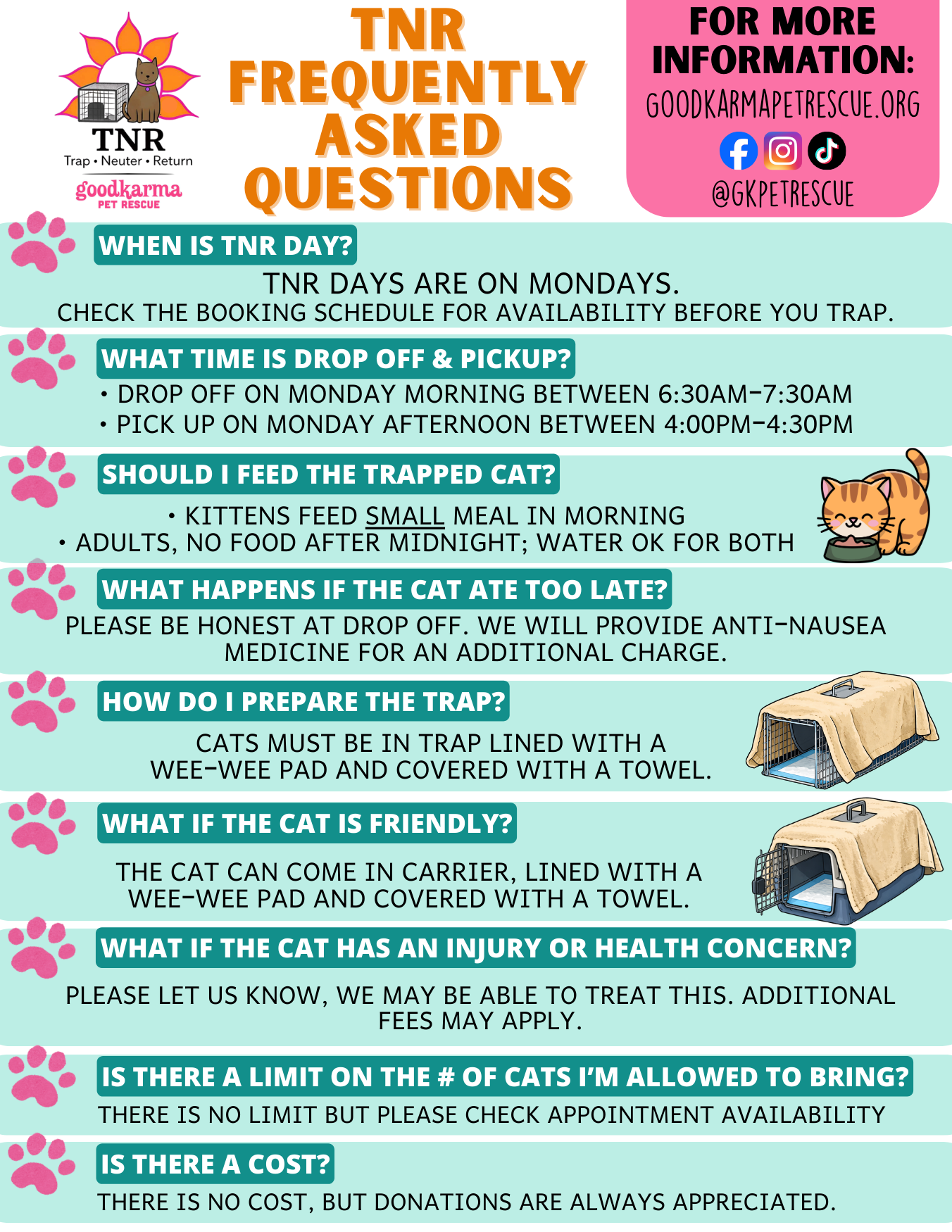
Important: read our FAQs below before making an appointment!
Our goal is to sterilize 2,000 community cats each year in South Florida. This will conservatively prevent the birth of more than 10,000 kittens annually since each unaltered female can produce multiple litters of 8–12 kittens per year. Over time, the impact compounds exponentially, as those kittens would also reproduce if left unaltered. Within just a few years, this program could prevent tens of thousands of additional cats from being born, reducing shelter intake, easing overcrowding, lowering euthanasia rates, and improving animal welfare across South Florida. Help us meet this goal by bringing in kitties on our TNR days!
Want to volunteer for TNR days? We’d love to have you! Please fill out our volunteer application.
Thanks to generous support from the community, we are happy to announce that we have introduced a Trap-Neuter-Release program for feral cats in the South Florida area commencing in January 2026.
In Broward County alone, there are an estimated 300,000 free-roaming cats. A Trap-Neuter-Vaccinate-Return (“TNVR” or “TNR”) program offers a proven, cost-effective, and humane solution. By sterilizing and vaccinating community cats, TNR reduces overpopulation, prevents the birth of unwanted litters, decreases shelter intake and euthanasia, lowers nuisance behaviors, and improves overall community health and safety.